How Rejesha works
Capture. Ledger. Reconcile. Account. See.
Rejesha runs the same loop every day. Records are captured where they happen, kept in a local ledger, reconciled against what is actually in hand, attributed to the person who entered them, and made visible to the owner.
- Sale
- Payment
- Stock movement
- Staff entry
- Ledger
- Reconciliation
- Audit
Capture
Sales, M-Pesa, cash, stock and expenses are recorded where they happen — at the counter, by the person who handled them.
- Sales, refunds and voids at the counter
- M-Pesa payments and cash payments
- Money paid out, with a reason
- Stock received and sold
Local Ledger
Every record is written to a ledger saved on the business computer first. A weak connection does not stop the day.
- Saved on the business computer first
- Useful when the connection is unreliable
- Every record keeps who entered it and when
- Export whenever you need to
Where the ledger lives
This computer
Ledger saved here first
Works without internet
Exported copy
Whenever you choose
Your file, your copy
No cloud sync or remote backup is claimed.
Diagram for explanation — not a product screenshot.
Reconciliation
Rejesha adds up what the day should have produced and compares it with what is actually in hand.
- Expected in hand against actually in hand
- M-Pesa matched from your imported statement
- Cash is the figure only a person can confirm
- Every line is the sum of records you can open
Monday, 10 August · Mwangi Stores
Actually in hand 83,750 minus expected in hand 84,250 gives a variance of minus 500.
The −500 sits in the cash drawer. M-Pesa is balanced.
| Channel | Expected | Actual | Difference |
|---|---|---|---|
| M-Pesa | 61,500 | 61,500 | Balanced |
| Cash drawer | 22,750 | 22,250 | −500 |
- Cash variance · −500 — drawer expected 22,750, counted 22,250.
- Refunds and adjustments · −1,300 already deducted in the expected position.
- Expenses and payouts · −8,700 already deducted, each with a reason.
- Unmatched M-Pesa · KES 3,980 across 3 payments — tracked on the M-Pesa screen, not part of this −500.
- Awaiting review · 1 name match, KES 1,160 — the owner confirms or rejects it.
- Context, not a conclusion · Brian recorded 1 sale without a printed receipt. The next step is to recount and ask.
Figures from the real Reconciliation and M-Pesa screens of the current build (demo ledger).
Accountability
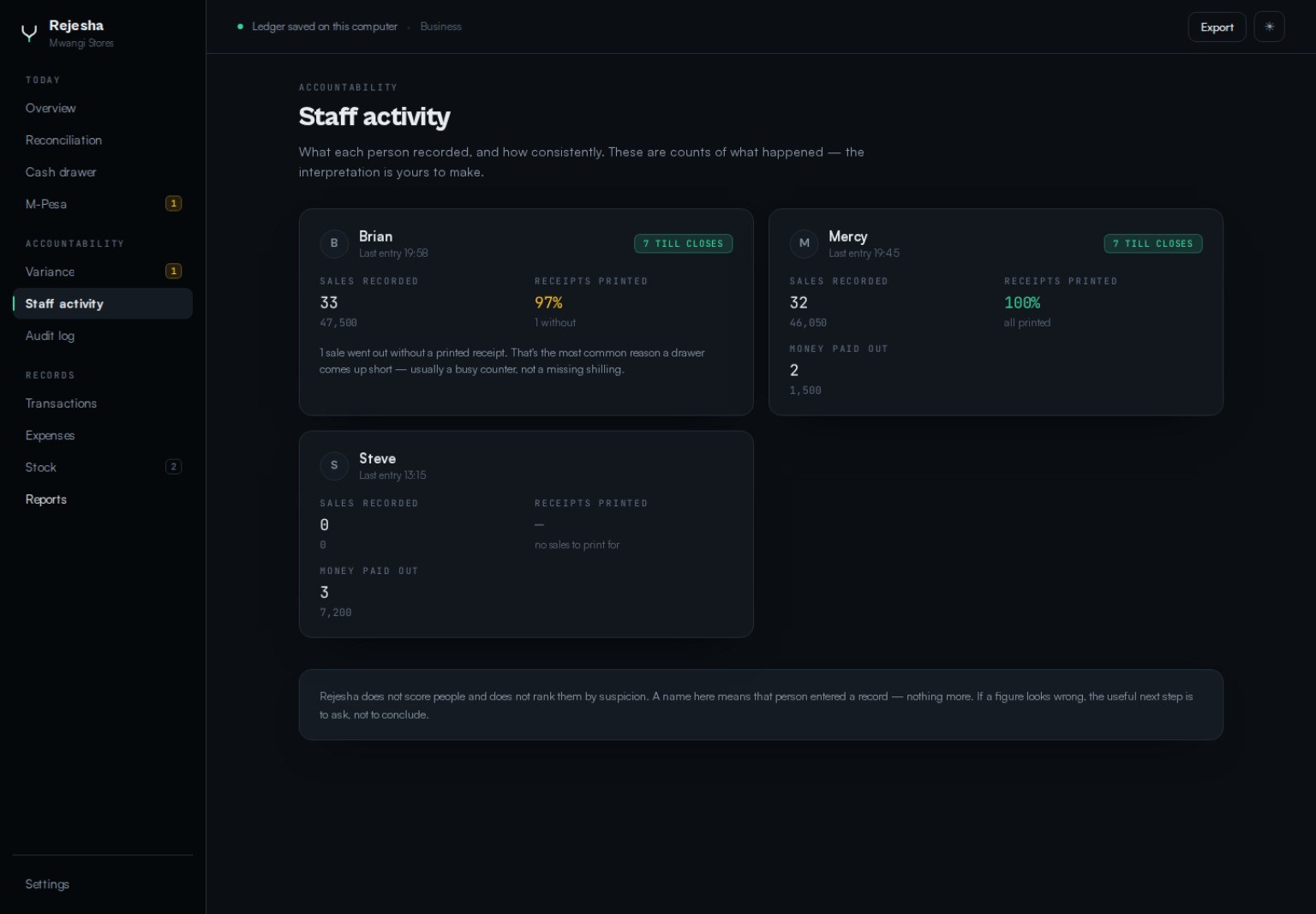
Each record carries who entered it and when. Differences point to records, not to people.
- Counts of what each person recorded
- Receipts printed, money paid out, till closes
- No scoring, no ranking by suspicion
- A name means that person entered a record — nothing more
Visibility
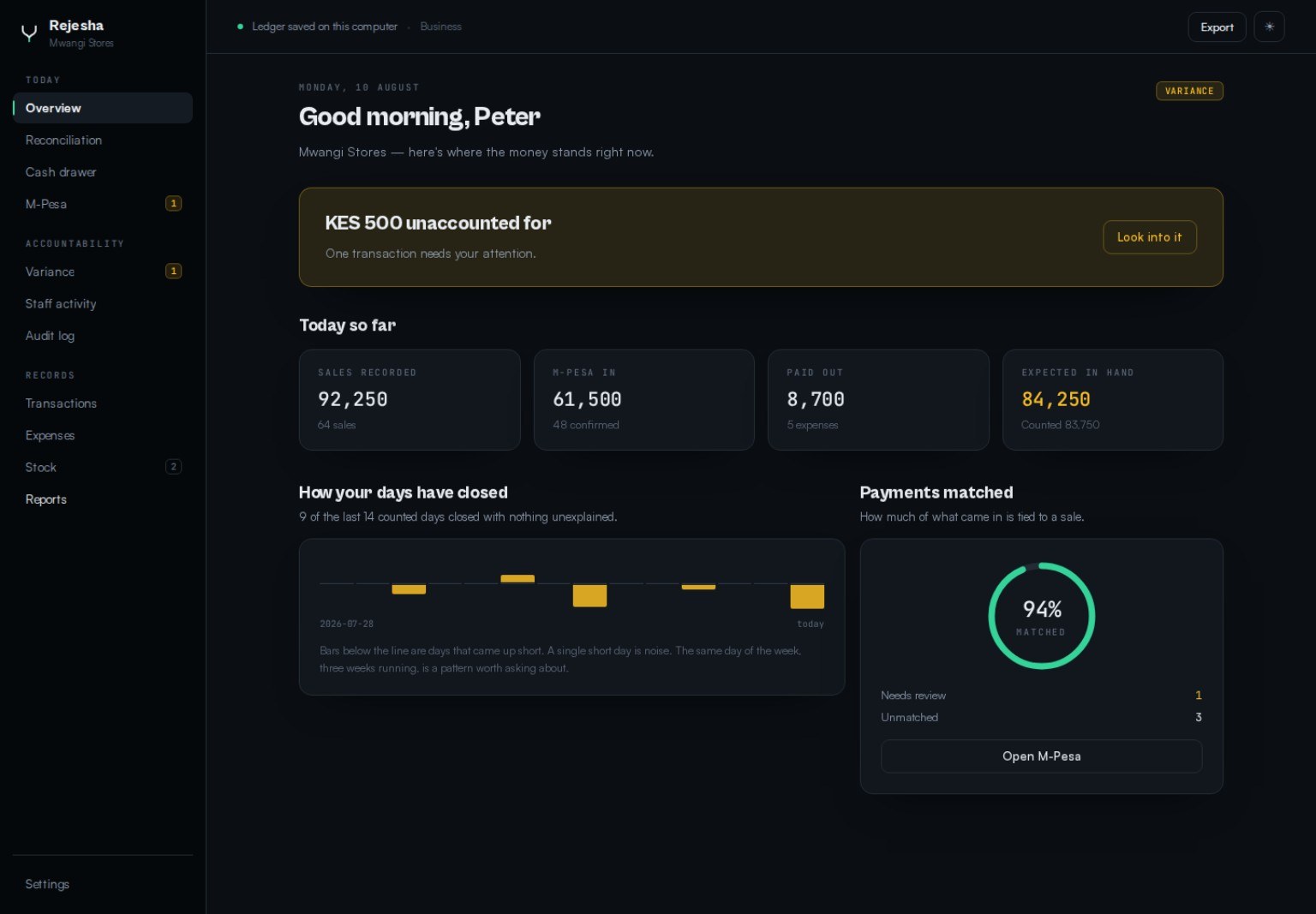
The owner sees where the business stands — today, this week, and across every closed day.
- Today so far, at a glance
- How your days have closed
- What needs your attention — and only that
- Patterns worth asking about, not noise
Pre-production · Controlled early access
Know where your business stands.
Rejesha is being built for businesses that want to know where their money, stock and daily operations stand. Join the waitlist to be among the first to experience it.